Field pilot live in Turkana, Kenya
Practical science,
without the
physical laboratory.
AlmsLabs gives secondary schools curriculum-aligned 3D science labs that run in any browser, on the devices they already have. No installs. No headsets. No equipment budget.
Per child
under $1 / mo
Aligned to
CBC · Cambridge · IB · NGSS
Runs on
Any browser, 2GB RAM
almslabs.online/labs/osmosis/run
9
Labs live today, 25 by market launch
6
Stage inquiry cycle in every lab
98%
Cheaper than equipping a physical lab
0
Installs, plugins or headsets required
The pedagogy
A simulation is not an experiment.
Most virtual labs let students click through a pre-baked animation. Ours walk the full inquiry cycle — students commit to a hypothesis before they touch the apparatus, and their reasoning is graded alongside their result.
01
Ask
Frame a testable question from the phenomenon on the bench.
02
Predict
Commit to a hypothesis in writing before any apparatus unlocks.
03
Plan
Choose variables, controls and the number of trials to run.
04
Investigate
Manipulate the 3D apparatus and record real measurements.
05
Analyse
Plot results, compute derived values, spot anomalous readings.
06
Conclude
Judge the hypothesis against evidence and state uncertainty.
The catalogue
Nine labs, four subjects
Physics45 minutes
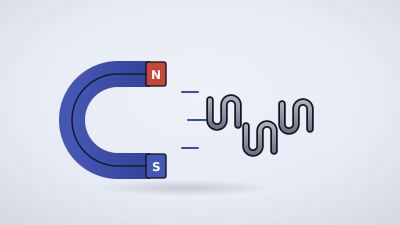
Magnetic Properties of Materials
Test ten everyday materials with a bar magnet and a horseshoe magnet to discover which are magnetic and which are not. Identify the property that all magnetic materials share.
Ages 12–14Open lab →
Biology50 minutes
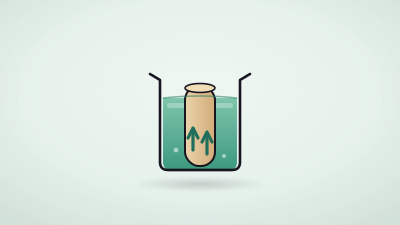
Osmosis
Place three potato cylinders into hypotonic, isotonic, and hypertonic solutions and watch them swell or shrink over 30 simulated minutes. Then use dialysis tubing with iodine and Benedict's tests to discover why membranes are selectively permeable.
Ages 13–15Open lab →
Mathematics60 minutes
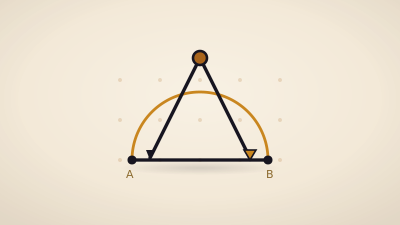
Geometric Construction
Build six classical compass-and-straightedge constructions on a virtual drafting surface — segments, perpendicular bisectors, angles, bisectors, and triangles. Discover the rules that make each one exact.
Ages 12–17Open lab →
Chemistry50 minutes
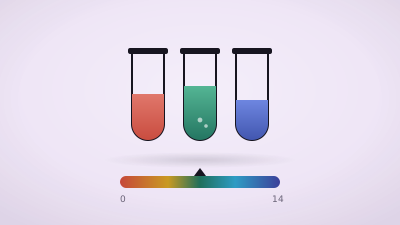
Acids & Bases
Classify nine unknown solutions using red and blue litmus paper, then extract a red cabbage indicator from scratch and test the same nine solutions to compare. Discover why some indicators reveal acid strength while others only tell you acid or base.
Ages 15–17Open lab →
Chemistry60 minutes
Paper Chromatography
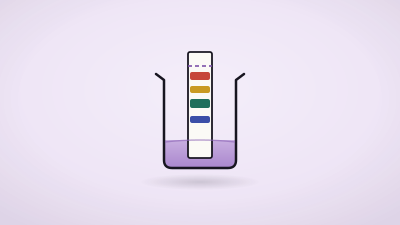
Discover the four hidden pigments inside a green leaf using paper chromatography. Apply a pigment spot, set up the solvent, watch the bands separate, and compute the Retention Factor (Rf) for each pigment — the same technique used in forensics and food science.
Ages 12–13Open lab →
Physics90 minutes
Classifying Energy Sources
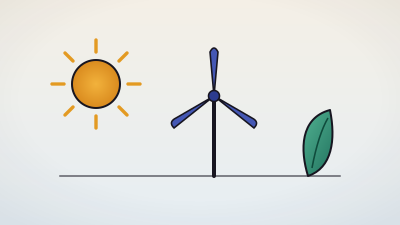
Investigate nine energy sources — solar, wind, hydro, geothermal, biomass, coal, oil, gas and nuclear — by their availability, environmental impact and production consistency, then sort each into renewable or non-renewable. Grounded in Kenya's own clean-energy story.
Ages 13–14Open lab →
Physics40 minutes
Properties of a Magnet
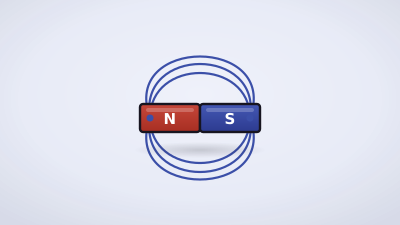
Discover what makes a magnet special: dip a bar magnet in iron filings to see its force is strongest at the poles, watch a freely suspended magnet settle North–South like a compass, and find the rule for when magnets attract and when they repel.
Ages 12–13Open lab →
Mathematics60 minutes
Area of a Triangle
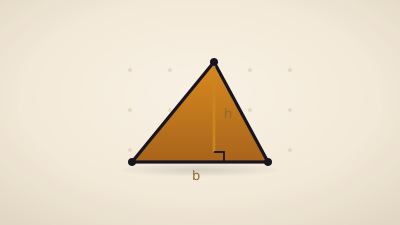
Find any triangle's area without ever measuring its height. Slide two sides and the angle between them to watch Area = ½·a·b·sin C come alive, then switch to Heron's formula to get the area from three sides alone — and finish by costing a real triangular plot in shillings.
Ages 15–16Open lab →
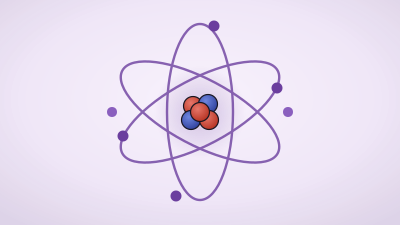
Chemistry60–90 minutes
Atomic Structure
Build atoms with the Bohr model. Pick an element (Z = 1–20) from the periodic table, watch its nucleus of protons and neutrons form, set the electron shells, and place electrons under the 2, 8, 8 rule — then read off its configuration, period, group and valence, and test yourself with an 8-question quiz.
Ages 14–15Open lab →
The economics
One physical lab, or every student for a decade.
One flat annual licence covers the whole school — unlimited learners, from $300 a year, under $1 per child a month. Set against $30,000–$100,000 up front and about $8,000 a year for reagents, glassware and a technician, the maths isn't close.
Request a district quotePhysical labAlmsLabs
Up-front cost$30k – $100k$0
Cost to run≈ $8k / yr73¢ / student / mo
Consumables & reagentsRecurringNone
Technician requiredYesNo
Experiments repeatableLimited by stockUnlimited